Final Structure 1
This research project uses computational modeling and mixed reality to turn irregular tree branches into
buildable architectural structures.
Computational Design
Mixed Reality
2025
.
.
CONTEXT
DURATION
TOOLS & SOFTWARE
TEAM SIZE
Research Project
6 weeks
Team of 3
Fologram, Microsoft
HoloLens, Rhino, Grasshopper
METHODS
Mixed Reality, Physical Fabrication, Machine Learning,
Computational Design
Photo-to-Fabrication
2025
.


Making Incision to Create Friction for the Joints


This research project explores how irregular tree branches can be translated into buildable architectural
systems through a photo-to-fabrication workflow. Using computational modeling, and mixed reality, the
project investigates how digital tools can enable non-standard, waste materials to be precisely
documented, structured, and assembled into spatial constructs.
Integrating naturally forked Y-branches, machine learning, and mixed reality (MR), the project develops
a design-to-fabrication workflow for creating two large-scale, material-efficient structures.

Plan and 3D Model of Structure 1
Final Structure 1
Mixed Reality Model of Structure 1
Plan and 3D Model of Structure 2
Final Structure 2
Mixed Reality Model of Structure 2
Structure 1
Structure 2

View From Headset of Layers and Model
Building of Structure

Our results show that:
1. Mixed reality enables non-experts to fabricate complex forms through real-time spatial guidance.
2. Digital tools extend technical drawings from static representations into active guides for fabrication.
3. Waste materials can be organized into systematic design frameworks.
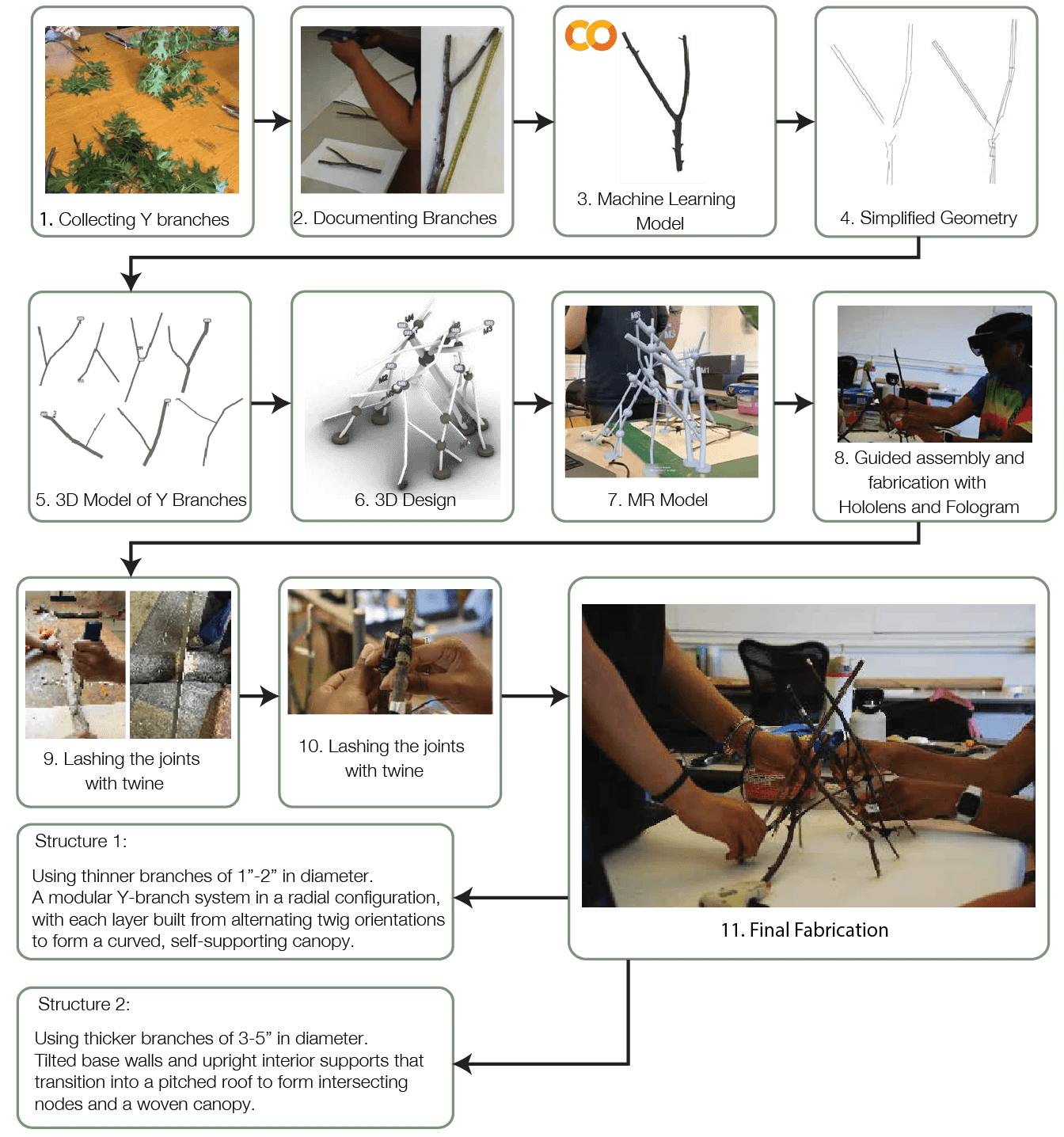
Workflow
Process Pictures
Building of Structure
Building of Prototype
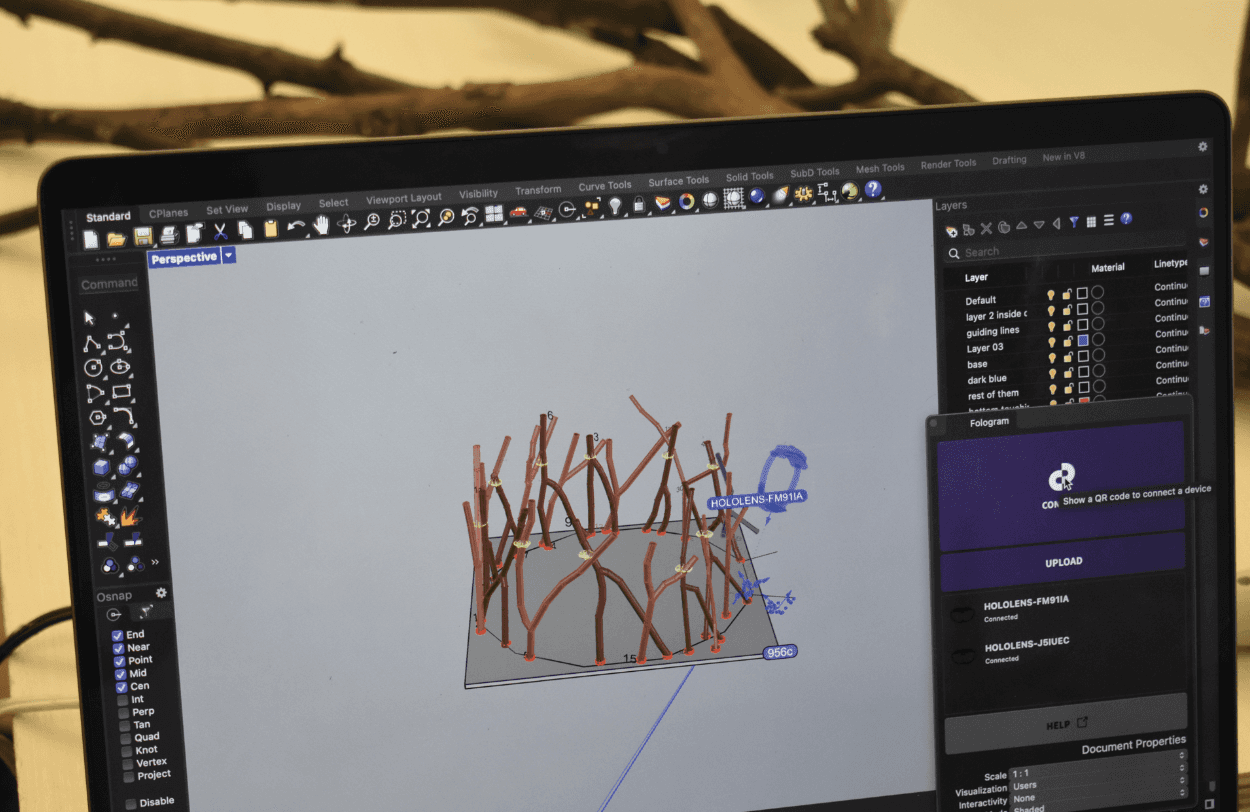
Live View of Headsets on Rhino Model
Building Prototype
Lashing the Joints
Making Incision to Create Friction for the Joints
Lashing the Joints
Final Structure 1
This research project uses computational modeling and mixed reality to turn irregular tree
branches into buildable architectural structures.
Computational Design
Mixed Reality
2025
.
.
CONTEXT
DURATION
TOOLS & SOFTWARE
TEAM SIZE
Research Project
6 weeks
Team of 3
Fologram, Microsoft
HoloLens, Rhino, Grasshopper
METHODS
Mixed Reality, Physical
Fabrication, Machine
Learning, Computational
Design
Photo-to-Fabrication
2025
.
Making Incision to Create Friction for the Joints
This research project explores how irregular tree branches
can be translated into buildable architectural systems
through a photo-to-fabrication workflow. Using
computational modeling, and mixed reality, the project
investigates how digital tools can enable non-standard,
waste materials to be precisely documented, structured,
and assembled into spatial constructs.
Integrating naturally forked Y-branches, machine learning,
and mixed reality (MR), the project develops a
design-to-fabrication workflow for creating two
large-scale, material-efficient structures.
Plan and 3D Model of Structure 1
Final Structure 1
Mixed Reality Model of Structure 1
Plan and 3D Model of Structure 2
Final Structure 2
Mixed Reality Model of Structure 2
Structure 1
Structure 2
View From Headset of Layers and Model
Building of Structure
Our results show that:
1. Mixed reality enables non-experts to fabricate complex
forms through real-time spatial guidance.
2. Digital tools extend technical drawings from static
representations into active guides for
fabrication.
3. Waste materials can be organized into systematic
design frameworks.
Workflow
Process Pictures
Building of Structure
Building of Prototype
Live View of Headsets on Rhino Model
Building Prototype
Lashing the Joints
Making Incision to Create Friction for the Joints
Lashing the Joints
Final Structure 1
This research project uses computational modeling and mixed reality to turn irregular tree
branches into buildable architectural structures.
Computational Design
Mixed Reality
2025
.
.
CONTEXT
DURATION
TOOLS & SOFTWARE
TEAM SIZE
Research Project
6 weeks
Team of 3
Fologram, Microsoft
HoloLens, Rhino, Grasshopper
METHODS
Mixed Reality, Physical Fabrication, Machine Learning,
Computational Design
Photo-to-Fabrication
2025
.
Making Incision to Create Friction for the Joints
This research project explores how irregular tree branches can be translated into buildable
architectural systems through a photo-to-fabrication workflow. Using computational modeling,
and mixed reality, the project investigates how digital tools can enable non-standard, waste
materials to be precisely documented, structured, and assembled into spatial constructs.
Integrating naturally forked Y-branches, machine learning, and mixed reality (MR), the project
develops a design-to-fabrication workflow for creating two large-scale, material-efficient structures.
Plan and 3D Model of Structure 1
Final Structure 1
Mixed Reality Model of Structure 1
Plan and 3D Model of Structure 2
Final Structure 2
Mixed Reality Model of Structure 2
Structure 1
Structure 2
View From Headset of Layers and Model
Building of Structure
Our results show that:
1. Mixed reality enables non-experts to fabricate complex forms through real-time spatial guidance.
2. Digital tools extend technical drawings from static representations into active guides for
fabrication.
3. Waste materials can be organized into systematic design frameworks.
Workflow
Process Pictures
Building of Structure
Building of Prototype
Live View of Headsets on Rhino Model
Building Prototype
Lashing the Joints
Making Incision to Create Friction for the Joints
Lashing the Joints